A’lam Madrasa

Short Historical Overview
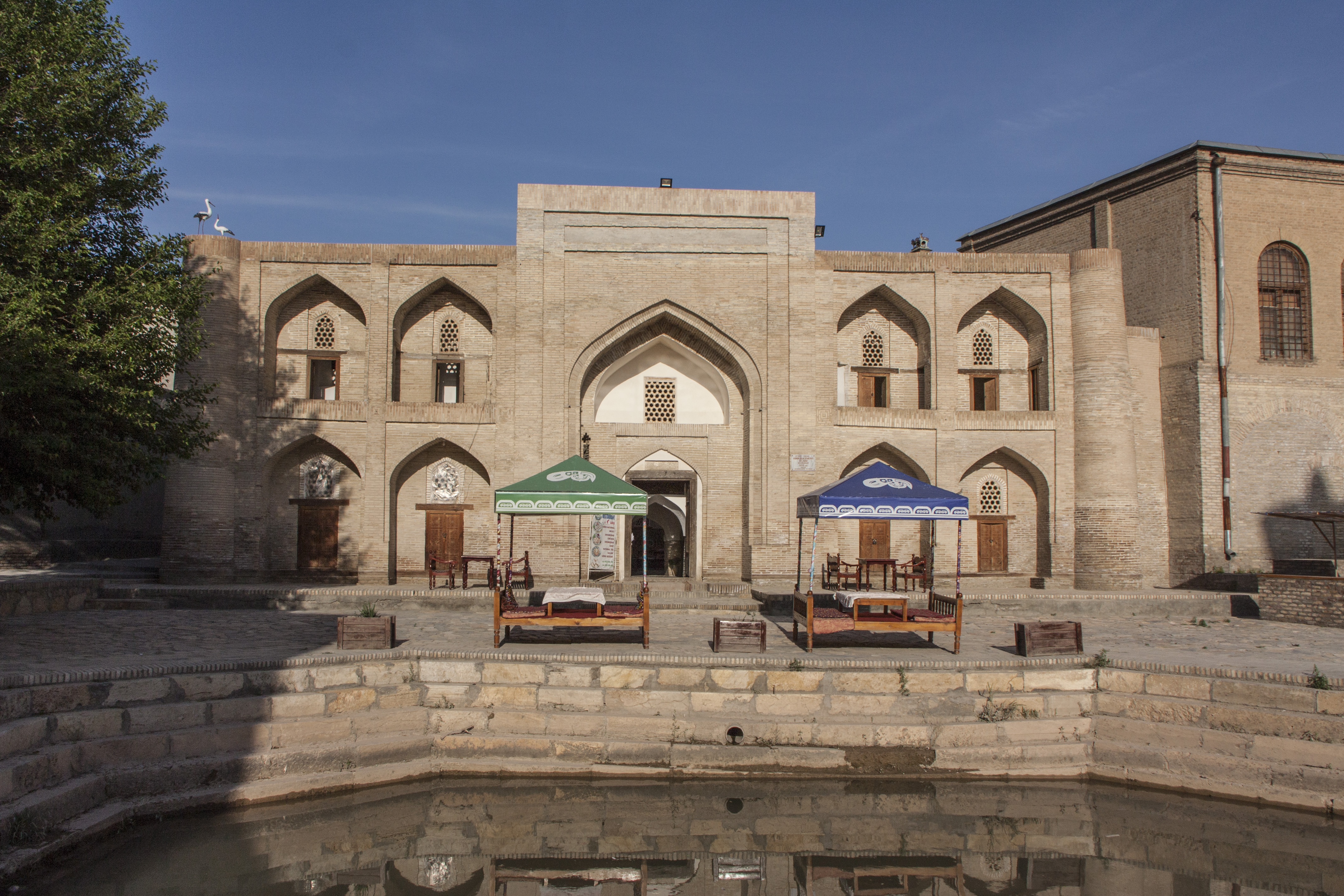
Constructed in 1825 by the Emir of Bukhara, Nasrullah Khan, the A’lam Madrasa was a center of Islamic scholarship. Named after a revered scholar, it attracted students from across Central Asia. Unlike older madrasas, it reflects late-period Bukharan architecture, with less grandeur but refined craftsmanship. It functioned as a religious school until the Soviet era, when it was repurposed for secular use. Post-independence, it was restored as a cultural site. Though smaller than the famed Kukeldash Madrasa, its historical role in education and theology makes it an important piece of Bukhara’s intellectual heritage.
Structural Insights
The madrasa follows a traditional courtyard layout, with student cells (hujras) lining the perimeter. Its façade features a modest portal with intricate tilework and carved wooden doors. The interior courtyard has a mosque and lecture halls, all adorned with geometric patterns in muted blues and greens. The brick construction includes decorative niches and arched alcoves. Unlike earlier madrasas, its ornamentation is simpler, reflecting 19th-century economic constraints. The structure’s compact design maximizes space efficiently, typical of late-era Bukharan religious schools. Restoration work has preserved its original charm while reinforcing its aging walls.
Legends
A legend claims that the madrasa’s founder, Emir Nasrullah, buried a cursed manuscript in its foundations. Anyone who disturbs it will face misfortune—a warning that kept Soviet archaeologists from excavating the site during their surveys of Bukhara.